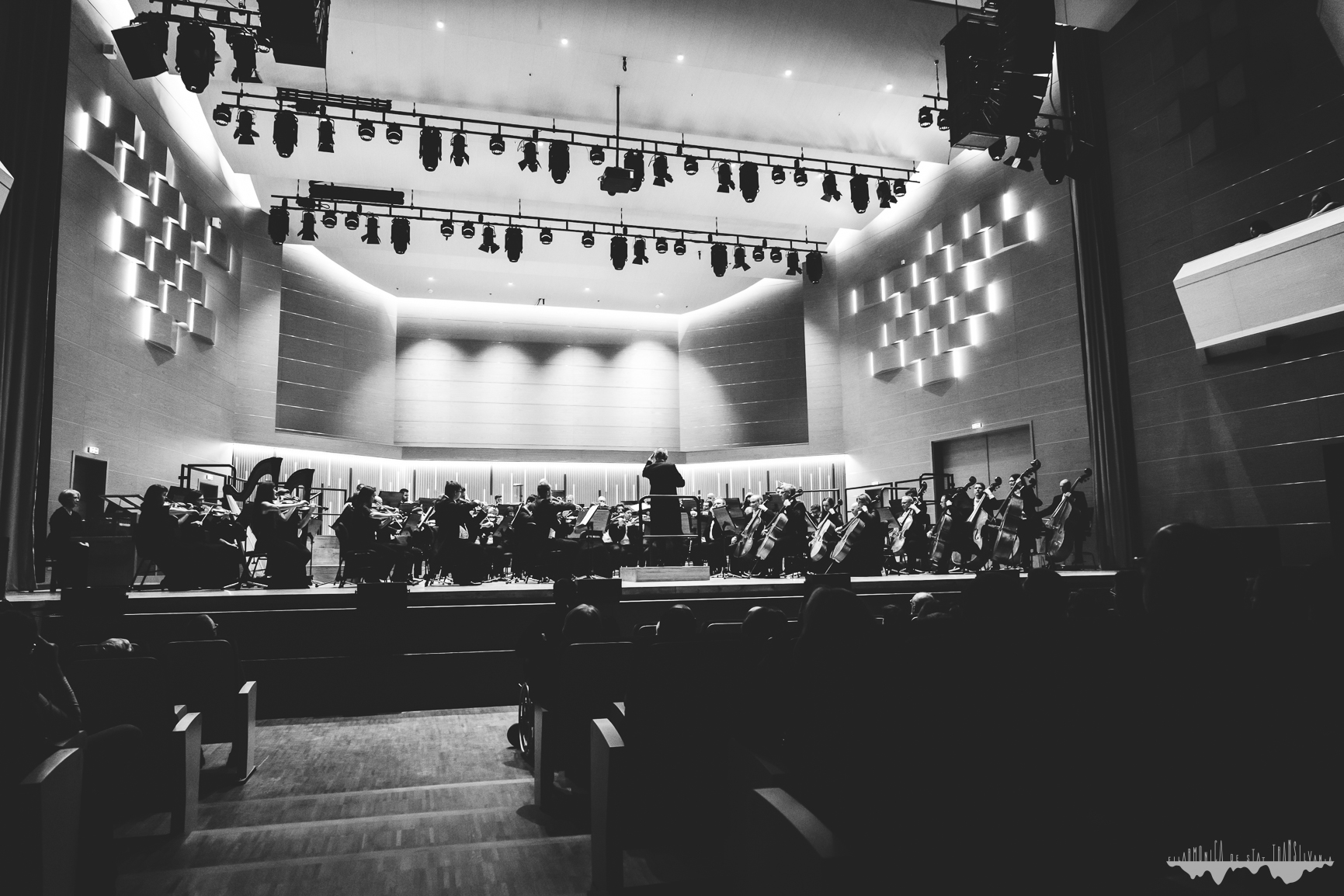
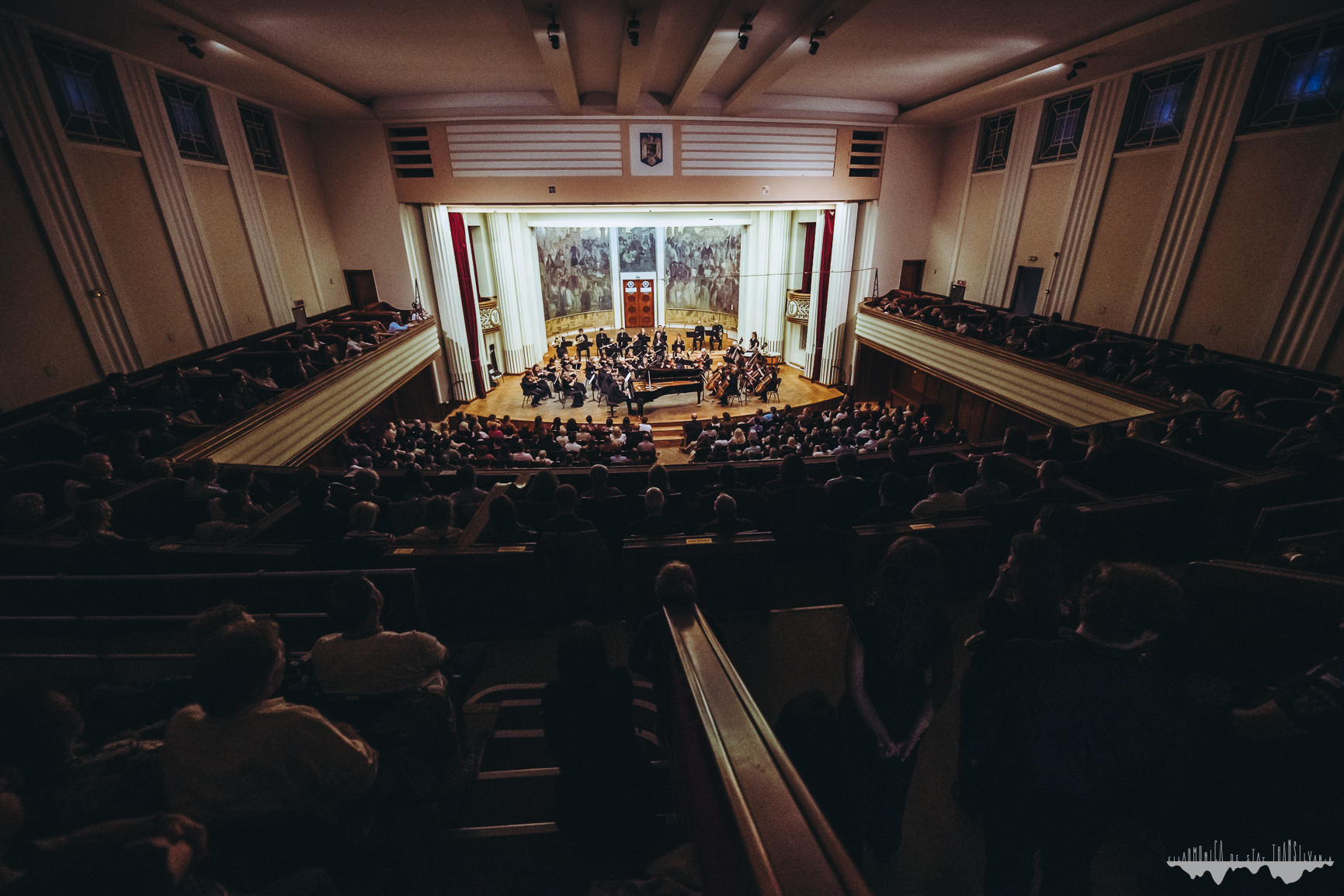
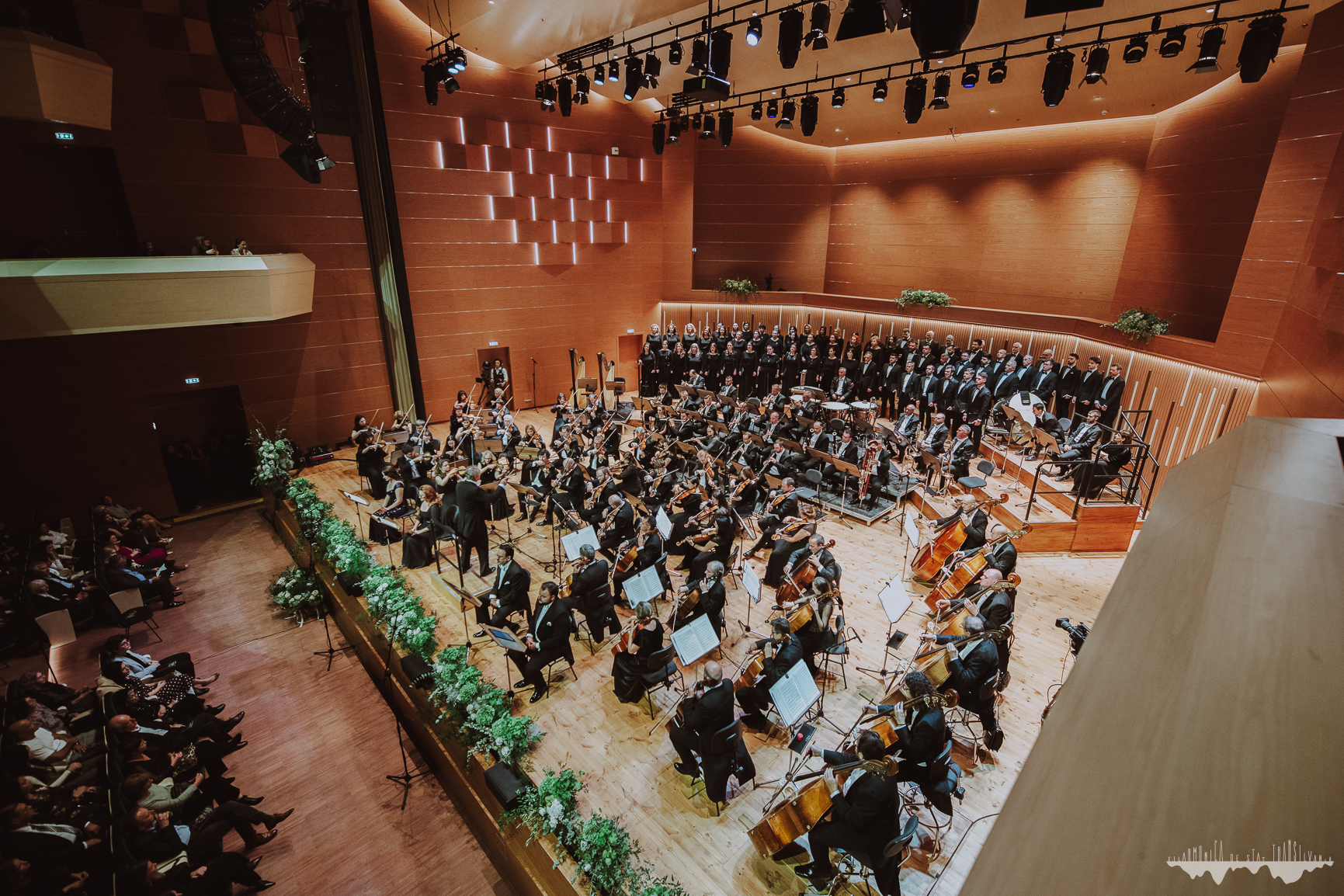
The Transylvania State Philharmonic is one of Romania’s representative musical institutions, with a history built on Cluj’s symphonic tradition, the excellence of the Cluj school of music, and encounters with great artists of the international stage.
Founded in the autumn of 1955 under the name of the Cluj State Philharmonic, the institution soon became a landmark of national musical life. Over the decades, the Philharmonic’s symphony orchestra, chamber orchestra, and choir have carried forward a solid artistic tradition, confirmed through concerts, festivals, tours, and discographic recordings.
1955
• The Cluj State Philharmonic was established by an official decree of the Council of Ministers of Romania.
• 4 December 1955: The first concert of the symphony orchestra, conducted by Antonin Ciolan.
1965
The launch of the “Cluj Musical Autumn” Festival.
1966
The establishment of the Philharmonic Chamber Orchestra.
1972
The establishment of the Philharmonic Choir, during the directorship of composer Sigismund Toduță.
1993
The adoption of the institution’s current name: the Transylvania State Philharmonic.
As an artistic institution dedicated exclusively to concert activity, the Cluj Philharmonic was founded in the autumn of 1955 under the name of the Cluj State Philharmonic. At the time of its establishment, the institution comprised two musical ensembles: a large symphony orchestra made up of 75 musicians and an instrumental ensemble of traditional music, made up of 20 musicians.
Under the initial coordination of conductor Wilhelm Demian, the members of the new institution were selected through auditions. The audition panels were chaired by the great conductor Antonin Ciolan, with the participation of the most reputed Cluj specialists of the time.
Antonin Ciolan was appointed principal conductor of the symphony orchestra and conducted its first concert, held on 4 December 1955. The programme was a true tour de force: Richard Wagner’s Prelude to Die Meistersinger von Nürnberg, Sigismund Toduță’s Concerto No. 1 for String Orchestra, Sergei Rachmaninoff’s Piano Concerto No. 2, with Silvia Șerbescu as soloist, and Ludwig van Beethoven’s Symphony No. 3, Eroica. At the beginning of 1956, Antonin Ciolan also took over as director of the Philharmonic.
The tradition of symphonic activity in Cluj dates back to the beginning of the 19th century, being successively maintained by ensembles and associations such as the Orchestra of the Hungarian Theatre, founded in 1792, the Music Society, and the Music Circle.
During the interwar period, the city’s musical life experienced a true flourishing, through symphonic events presented by the orchestras of the Romanian Opera, founded in 1919, the Hungarian Theatre, as well as by the “Goldmark” Orchestra, an ensemble supported by the city’s Jewish community and conducted by Wilhelm Demian.
In 1947, the first attempt was made to establish a concert institution, the “Ardealul” Philharmonic. Although its existence was short-lived, lasting only two seasons, it laid the groundwork for the later success.
The Philharmonic’s progress was remarkably swift thanks to the formative activity of Maestro Antonin Ciolan and to the excellent training of the young musicians educated at the Cluj Academy of Music, then the “Gheorghe Dima” Conservatory of Music.
From the very beginning, some of the most prestigious Cluj soloists of the time were co-opted alongside the institution’s musical ensembles: flautist Dumitru Pop and pianist Gheorghe Halmos. They were later joined by violinist Ștefan Ruha, an artist who would go on to build a remarkable international career while remaining faithful to the Philharmonic for three decades.
From its earliest years, exceptional disciples of Maestro Ciolan distinguished themselves at the podium of the symphony orchestra, including conductors Emil Simon and Erich Bergel. Another reference name in Romanian conducting, Cristian Mandeal, experienced one of the most fruitful periods of his artistic development at the podium of the Cluj orchestra.
The Cluj Musical Autumn Festival, the Chamber Orchestra, and the Choir
In 1965, the Philharmonic launched its own annual festival, the “Cluj Musical Autumn”, a landmark event in Cluj’s cultural life, successfully continued to this day.
One year later, in 1966, the Philharmonic Chamber Orchestra was founded, as the result of collaboration with the reputed conductor Mircea Cristescu.
In 1972, during the directorship of composer Sigismund Toduță, Antonin Ciolan’s successor at the helm of the institution, the Philharmonic Choir was established. The choral ensemble was formed by Maestro Dorin Pop, and its activity was later continued by his disciples, Florentin Mihăescu and Cornel Groza.
Over time, the Philharmonic has had the privilege of collaborating with distinguished guests, legendary names of performance and composition: Stanisław Wisłocki, Kurt Masur, Kirill Kondrashin, Jean-Pierre Rampal, Witold Lutosławski, Carlo Zecchi, Yannis Xenakis, János Ferencsik, Aldo Ciccolini, Krzysztof Penderecki, Michi Inoue, Stefan Anton Reck, Sir John Pritchard, Anatole Fistoulari, George Georgescu, André Jolivet, Edvard Tchivjel, Adrian Sunshine, Horia Andreescu, Laurent Petitgirard, Maurice Handford, Leopold Hager, Valery Gergiev, Alexandr Dmitriev, Lawrence Foster, Antonello Allemandi, Sascha Goetzel, John Axelrod, Jörg Widmann, Monique Haas, Sviatoslav Richter, Ruggiero Ricci, Valentin Gheorghiu, Friedrich Gulda, Annie Fischer, Dmitri Bashkirov, Dan Grigore, Lazar Berman, Radu Lupu, Silvia Marcovici, Mihaela Martin, Bruno Leonardo Gelber, Patrik Gallois, José Carreras, Angela Gheorghiu, Philippe Entremont, Roberto Alagna, Raphael Wallfisch, David Grimal, Tatiana Lisnic, Freddy Kempf, Christian Lindberg, Liviu Prunaru, Raúl Jaurena, Marcel Khalifé, and many others.
The presence of these great artists has contributed to the consolidation of an international artistic standard and to the ensemble’s strong reputation within international musical circles. The numerous tours undertaken abroad by both the symphony orchestra and the choral ensemble have confirmed this reputation.
An important discographic output also remains as testimony to the enduring values created over the decades by the musicians of Cluj.
At the helm of the Philharmonic, the two great founders, Antonin Ciolan and Sigismund Toduță, were followed by prominent figures of Cluj’s cultural life: writer Dumitru Mircea, musicologist Rodica Oana Pop, violinist Radu Grecu, composer Adrian Pop, violinist George Dudea, conductor Emil Simon, manager Denisa Piteiu, violinist Dorina Mangra, as well as pianist and translator Marius Tabacu.
During the directorship of composer Adrian Pop, in 1993, the institution adopted its current name: the Transylvania State Philharmonic.
Passing through both more prosperous and more difficult stages, successive generations of artists and managers have known how to preserve and develop the traditions, values, and prestige of the institution.
At present, the manager of the Transylvania State Philharmonic is pianist Silvia Sbârciu.